

Smart textile sensors are advanced monitoring devices used in textile manufacturing to measure humidity, temperature, and fabric moisture in real time. They help optimize drying processes, reduce energy consumption, and improve product quality through automated process control.
Why Energy Efficiency Matters in Technical Textile Production
 As energy prices, sustainability requirements and quality expectations continue to rise, manufacturers of technical textiles face increasing pressure to optimize efficiency while ensuring process reliability. At the same time, skilled labor shortages require production systems that are intuitive, automated and easy to manage. PLEVA addresses these challenges with robust, maintenance-friendly sensor technologies combined with intelligent process control.
“In times of economic pressure, PLEVA’s smart sensor and control solutions turn process transparency into measurable savings — reducing energy consumption, ensuring consistent quality and increasing productivity in technical textile production.” says, Kathrin Pleva, Management.
Intelligent Measurement for Transparent Drying Processes
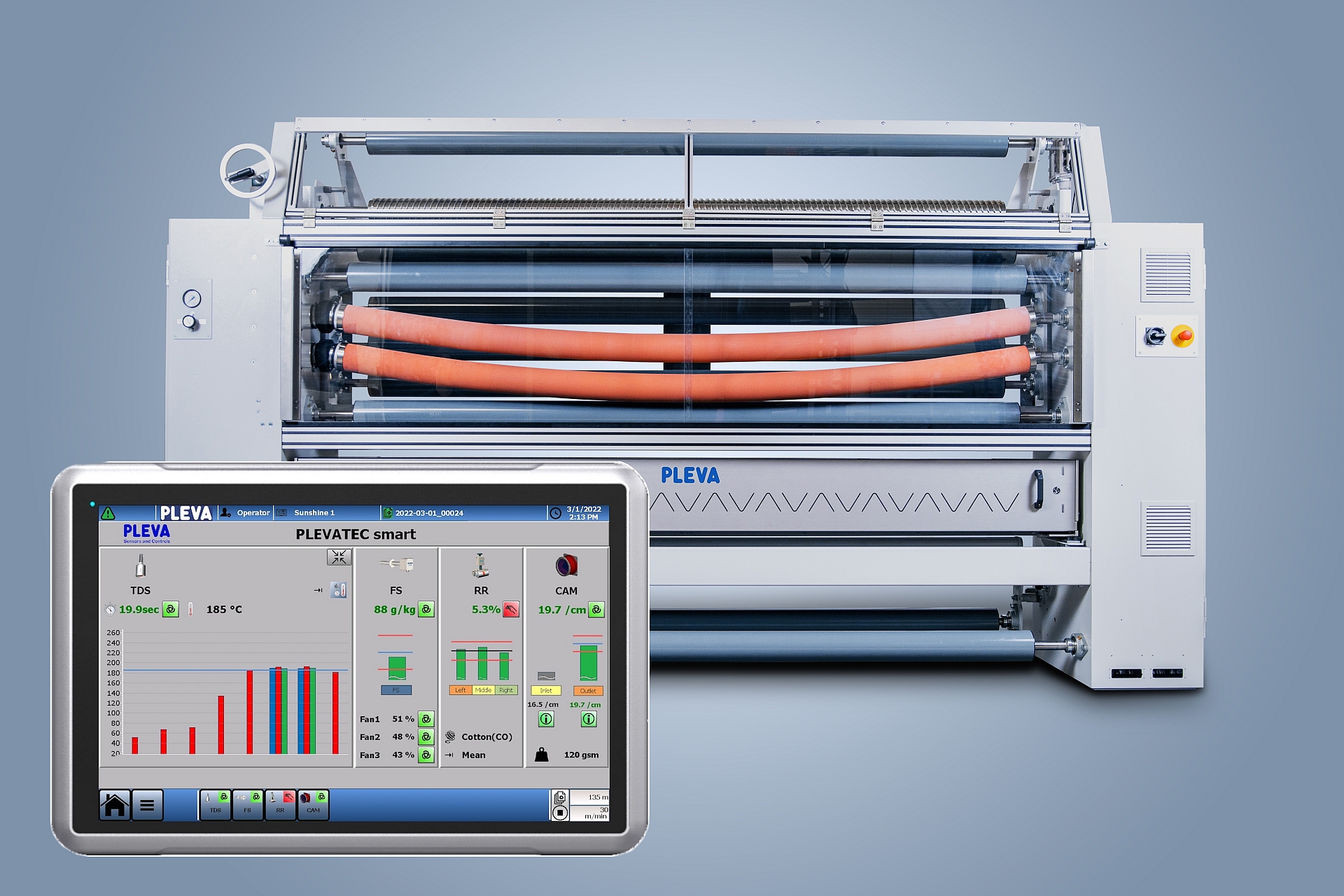
Modern textile finishing is highly energy-intensive. Precise and continuous monitoring is essential to avoid overdrying, reduce emissions and maintain consistent product quality. PLEVA’s modular control platform PLEVATEC smart integrates multiple sensor technologies into one intelligent system: Exhaust humidity measurement (FS X) for optimized energy usage, Fabric and air temperature measurement (TDS) for controlled heat transfer, Residual moisture measurement (RR) for precise drying results and Camera systems (CAM) for distortion detection and pick/course density monitoring.
This holistic approach provides full process transparency and enables automated, reproducible production.
The benefits are measurable: Significant energy savings, reduced CO₂ emissions, increased drying capacity, improved product consistency and fewer rejects and less rework.
Practical applications demonstrate productivity increases of up to 16% and noticeable reductions in electrical and thermal energy consumption when smart sensor technology is applied.
High-Tech Camera Systems for Demanding Technical Textiles
In addition to drying control, PLEVA offers advanced camera-based straightening systems for woven and knitted technical textiles. The unique traversing camera technology captures a high number of measurement points across the full fabric width — from edge to edge — enabling precise detection and correction of skew and bow distortion. This technology ensures reliable straightening performance even with complex structures, dense fabrics or high-value technical materials.
Smart Automation for Sustainable Production
PLEVA’s philosophy is clear: Smart sensors lead to smart savings. By combining precise measurement technology with intelligent control algorithms, manufacturers can: Stabilize processes, reduce energy consumption, increase throughput, minimize operator dependency and enhance sustainability performance.
With worldwide service bases and long-standing expertise in textile process automation, PLEVA supports customers globally in implementing future-ready production concepts.
PLEVA Innovations at Techtextil Frankfurt 2026
Visit PLEVA at Techtextil Frankfurt, hall12.0, booth E58. At Techtextil, PLEVA will demonstrate how intelligent sensor systems and smart automation create measurable value in technical textile production — from energy savings to improved quality and reproducibility.
FAQ Section
What are smart sensors in textile finishing?
Smart sensors in textile finishing monitor parameters such as humidity, temperature, and residual moisture in real time to optimize drying efficiency, reduce energy consumption, and improve fabric quality.
How do textile sensors reduce energy consumption?
Sensors measure exhaust humidity, fabric temperature, and moisture levels during drying. This data allows automated systems to adjust heat and airflow, preventing overdrying and saving energy.
What is textile drying process optimization?
It is the use of intelligent monitoring systems and automation to control drying conditions, ensuring consistent moisture levels, reduced energy usage, and stable production quality.
Why is automation important in textile manufacturing?
Automation reduces dependence on manual operations, improves process stability, increases productivity, and supports sustainable manufacturing practices.
What technologies are used for textile distortion detection?
Advanced camera systems analyze fabric structure across the entire width to detect skew, bow, and distortion, enabling automated straightening corrections.
Learn next about Netherlands Pavilion Highlights Circular Textile Innovation at Techtextil Frankfurt