

Pakistani exporters have expanded their reach beyond the United States and successfully entered the European market, as Pakistani carpets gained strong attention at the world’s largest home textile exhibition, Heimtextil, currently underway in Frankfurt, Germany.
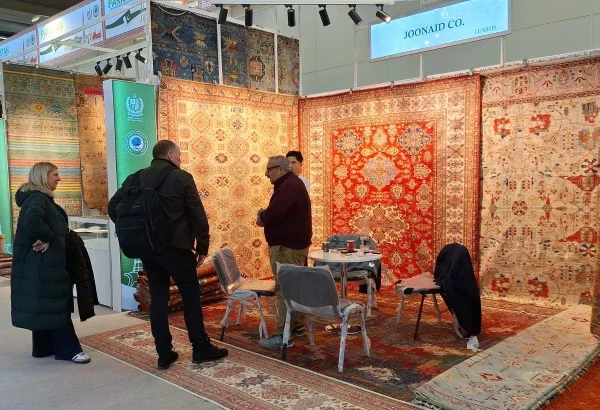
Handmade Pakistani carpets have attracted European buyers with their traditional designs and craftsmanship. Exporters participating in the exhibition say the response has been better than expected, raising hopes for the revival of Pakistan’s struggling carpet industry. Recent additional tariffs imposed by the United States on Indian products have also created new opportunities for Pakistani manufacturers.
This year, a dedicated national pavilion showcasing Pakistani carpets has been set up at Heimtextil. Ten Pakistani companies are taking part, most of them small exporters. For many, this is their first direct experience of marketing Pakistani carpets to European buyers, marking an important step toward diversifying export destinations.
Chairman of the Pakistan Carpet Manufacturers and Exporters Association, Mian Atiq ur Rehman, who is also exhibiting at the fair, expressed satisfaction over Pakistan’s renewed presence at an international exhibition after many years. He said the encouraging response shows that global interest in Pakistani carpets still exists.
Speaking about the industry’s decline, he said Pakistan’s carpet exports peaked at around 350 million dollars in the year 2000 but have now fallen to nearly 70 million dollars. Traditionally, Pakistani carpets were exported mainly to the United States, Australia, and South Africa, with the US remaining the largest market. However, improved trade ties with the US did not significantly boost carpet exports.
Mian Atiq ur Rehman noted that despite decades of unfavorable conditions, the industry survived for nearly 25 years without subsidies or government support. During this period, the art of carpet weaving, an important part of Pakistan’s cultural heritage, gradually declined. He emphasized that carpets are closely linked to Pakistan’s identity and global image.
He explained that Pakistan was once known for producing fine, intricate carpet designs that were expensive and later lost popularity. Over time, the industry shifted toward vegetable dyes and machine-based looms, although traditional handwoven carpets are still produced in the country.
Commenting on the impact of US tariffs on Indian carpets, he said India responded by increasing subsidies and rebates for its exporters, reducing the effect of the tariffs. Despite this, he believes Pakistan still has strong potential in the international market for handmade carpets, especially as India has largely moved to machine-made production.
He stressed that to fully realize this potential and restore the carpet industry, strong government support and policy backing are essential.