

Industry 5.0 textiles are redefining the future of textile manufacturing by combining human expertise with advanced automation, AI and connected machinery. Unlike earlier industrial revolutions focused mainly on mechanisation, Industry 5.0 emphasises collaboration between skilled workers and intelligent systems to create more sustainable, efficient and resilient textile production environments. As spinning, weaving and knitting technologies evolve, textile manufacturers are adapting to a new workforce model driven by digital transformation and smart manufacturing.
What is Industry 5.0 in Textile Manufacturing?
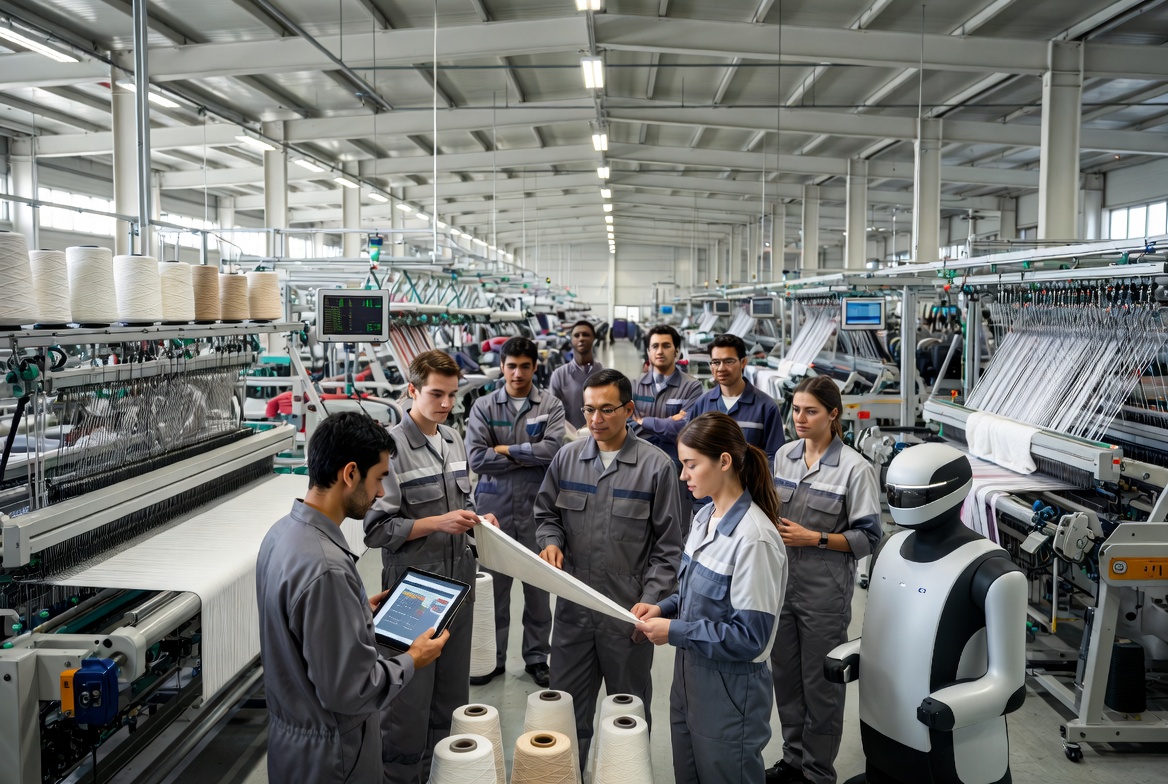
As automation reshapes textile manufacturing, the industry is entering a new era where human expertise and intelligent machines work side by side.
Textile manufacturing is entering a new phase of transformation. As digital technologies, AI and connected machinery reshape production environments, the role of human workers is evolving alongside machines.
This shift reflects the emerging concept of Industry 5.0, where advanced manufacturing technology and human expertise work together to create safer, more resilient and more sustainable textile manufacturing systems.
While many predictions focus on extraordinary gains in efficiency, precision and capability, there remains an undercurrent of concern that advanced automation may ultimately displace skilled labour. Yet history reminds us that such tensions are far from new.
What is advanced manufacturing?
To understand how this shift is unfolding in textiles today, it helps to first define advanced manufacturing. Advanced manufacturing refers to the use of technologies such as sensors, data analytics, AI, robotics and connected equipment to improve productivity, quality, agility and sustainability.
In textile production, these technologies allow spinning, weaving, knitting and finishing machines to operate as advanced manufacturing systems, continuously exchanging data to optimise production performance across the mill.
Advanced automation is a subset of this transformation. It focuses on the use of intelligent machines, robotics and software to perform tasks with minimal human intervention, streamlining workflows and enabling more efficient, data-driven textile manufacturing.
A two-century echo: from Jacquard to connected production
More than two centuries ago, the invention of the Jacquard loom triggered a transformation that closely mirrors today’s digital revolution. The technological lineage that began with this groundbreaking machine can be traced directly to the sophisticated digital production technologies now reshaping textile manufacturing.
The advanced technologies that will be showcased at ITMA 2027 in Hanover, Germany, represent the latest steps in this continuing evolution of textile manufacturing.
When the Jacquard loom was introduced into Britain during the 1820s, it fundamentally altered textile production. Tasks that had once required years of training and craftsmanship could suddenly be performed more efficiently, enabling complex woven designs to be produced faster and at significantly lower cost, delivering substantial commercial advantages to mill owners.
As with today’s advances in automation and AI, the technology was accompanied by enthusiastic predictions about its transformative potential, alongside deep concerns about its implications for employment.
The social response was dramatic.
The rapid mechanisation of the British textile sector contributed to the rise of the Luddite movement, whose workers protested against machines that threatened their livelihoods. Mills were attacked and machinery destroyed in acts driven by genuine fears of economic displacement.
In retrospect, those concerns were not entirely misplaced, yet they represented only part of the story. Alongside the disruption emerged new opportunities, as a generation of engineers, technicians and machine specialists began to redefine the workforce and elevate the technical sophistication of the industry.
Today, this pattern of disruption followed by workforce evolution continues to define the trajectory of textile manufacturing.
AI, Workflow Automation and Connected Textile Mills
The debate surrounding automation and employment is once again intensifying as digital technologies accelerate across manufacturing sectors. Yet the textile industry’s long history suggests that technological disruption rarely results in simple labour replacement. Instead, it tends to reshape skill requirements, elevating technical knowledge while creating new roles in engineering, process optimisation and digital production management.
While new opportunities are emerging, the transition remains uneven across regions and companies, particularly where access to skills, infrastructure and investment is limited.
Programmable logic in pattern creation
At the heart of Jacquard weaving was a remarkably forward-thinking approach to pattern creation – designs were first developed on gridded paper before being translated into a sequence of punched cards. Each punched hole represented a specific thread movement within the loom, with columns and rows corresponding to individual points within the fabric structure. When joined together into continuous chains and fed into the machine, these cards directed the movement of numerous threaded rods, enabling the production of intricate patterns with unprecedented accuracy and consistency.
This system effectively introduced one of the earliest forms of programmable manufacturing. The logic underpinning textile structures can be interpreted in binary terms, with yarns interacting through alternating interlacements that echo the fundamental on-off principles of modern computing. It is therefore unsurprising that Joseph Marie Jacquard’s punch card concept went on to inspire Charles Babbage in the development of his Analytical Engine – widely regarded as a foundational step towards modern computer science.
Human-Machine Collaboration in the Textile Industry
Two centuries later, the textile machinery sector is once again undergoing profound transformation. Today’s spinning, weaving and knitting platforms are increasingly being defined by digital integration, advanced automation and smart manufacturing technologies that enable real-time process intelligence.
Investment in automation and digital manufacturing systems is continuing to rise across textile mills as producers seek greater efficiency, flexibility and operational resilience. This trend is reflected in market forecasts from Technavio, which estimate that the global textile automation market will grow by USD 664 million, at a CAGR of 3.2% between 2024 and 2029.
Machines now operate as part of interconnected production ecosystems. This is where workflow automation becomes visible: data and machine logic reduce manual interventions, enabling manufacturers to monitor performance, optimise efficiency and respond dynamically to changing production requirements.

The effectiveness of these systems, however, remains closely tied to underlying process knowledge and data quality, highlighting the continued importance of engineering expertise.
Sustainability and Industry 5.0 Textile Technologies
Beyond transforming productivity and design capability, successive generations of textile technology have also fundamentally reshaped the working environment within mills. Many of the tasks that once defined textile production were not only highly repetitive but also physically demanding and, in some cases, hazardous.
Operators were historically required to manually handle heavy beams, monitor multiple machines simultaneously and intervene frequently to correct faults or replace broken yarns. Such work demanded intense concentration and physical endurance, often under challenging environmental conditions.
The Future Workforce of Textile Manufacturing
Modern machine design has steadily reduced these burdens. Automated handling systems now assist with the movement and positioning of heavy warp beams and fabric rolls, significantly reducing the need for manual lifting and minimising the risk of injury.
In practice, integrating these technologies into existing production environments remains complex, requiring careful alignment between systems, processes and workforce capabilities.
Advanced sensor technologies continuously monitor yarn tension, fabric quality and machine performance, allowing systems to detect and correct faults automatically or alert operators only when intervention is genuinely required.
This not only improves product consistency but also allows operators to focus on higher value supervisory and technical responsibilities rather than repetitive manual adjustments.
Ergonomic design has also become a central consideration in contemporary textile machinery. Improved machine layouts, intuitive touchscreen interfaces and simplified control architectures have made operation more accessible while reducing operator fatigue.
Maintenance procedures that once required time-consuming dismantling are increasingly supported by modular machine components and predictive maintenance systems, allowing servicing to be planned efficiently and carried out with minimal disruption.

Industry 5.0: A Human-Centric, Sustainable and Resilient Approach
Digital connectivity is further enhancing the operator’s role by providing real-time production data and performance analytics.
Rather than reacting to problems after they occur, technicians and machine operators can now anticipate issues, optimise settings and manage production with a level of precision that would have been unimaginable in earlier eras.
Training requirements are evolving accordingly, shifting away from purely manual skillsets towards hybrid competencies that combine textile knowledge with digital literacy and process engineering.
This shift is redefining the skill profile of the textile workforce, with increasing demand for operators who can combine technical expertise with digital and analytical capabilities.
These developments reflect the broader shift towards Industry 5.0, which places human expertise, sustainability and resilient production systems at the centre of technological progress.
Rather than viewing automation purely as a means of replacing labour, Industry 5.0 emphasises human-machine collaboration, where advanced machinery works alongside skilled operators to enhance productivity and decision-making.
Within textile manufacturing, this shift is becoming particularly significant as producers face mounting pressure to reduce environmental impact while maintaining productivity and competitiveness.
Digital machine platforms are enabling more precise control over energy consumption, water usage and raw material efficiency, helping manufacturers minimise waste and optimise resource utilisation throughout the production process.
Advanced monitoring systems can track performance parameters in real time, allowing mills to identify inefficiencies quickly and implement corrective measures that reduce both operating costs and environmental footprint.
ITMA 2027 and the Next Generation of Textile Innovation
Process integration and data-driven optimisation are also supporting the development of more flexible and demand-responsive manufacturing models.
By enabling shorter production runs, faster changeovers and more accurate forecasting, modern textile technologies help reduce overproduction and excess inventory, challenges that have historically contributed to material waste across the industry.
At the same time, improved process stability and consistency support the use of recycled fibres and alternative raw materials, helping manufacturers align with evolving sustainability targets without compromising product quality.
In many respects, this progression echoes the transformation first initiated by the Jacquard loom. While early mechanisation reduced certain traditional crafts, it simultaneously elevated the technical sophistication of textile production and broadened the range of opportunities available to the workforce.
Many of these developments will continue to be explored at ITMA 2027, where industry stakeholders come together to exchange insights and examine the technologies shaping the next phase of textile manufacturing.
As the textile industry moves deeper into the era of Industry 5.0, the relationship between intelligent machines and skilled operators will become even more central to manufacturing competitiveness. The technologies enabling this transformation will continue to shape the future of textile manufacturing, redefining how production is managed, optimised and sustained in the years ahead.
FAQs
What is Industry 5.0 in textiles?
Industry 5.0 in textiles refers to the integration of human expertise with AI, automation and smart manufacturing technologies to improve productivity, sustainability and workforce collaboration in textile production.
How does Industry 5.0 affect textile workers?
Industry 5.0 shifts textile workers from repetitive manual tasks toward higher-value roles involving machine supervision, data analysis, digital operations and process optimization.
Why is automation important in textile manufacturing?
Automation improves production efficiency, product consistency, energy management and workplace safety while enabling textile manufacturers to respond faster to market demands.
How is AI used in textile manufacturing?
AI is used for predictive maintenance, quality control, workflow automation, machine monitoring and production optimization in textile mills.
What role do workers play in Industry 5.0 textiles?
Workers increasingly focus on technical supervision, digital operations, machine analytics and process engineering rather than repetitive manual labor.
How does automation improve textile manufacturing?
Automation enhances productivity, reduces waste, improves product consistency and helps manufacturers optimize energy and resource consumption.
What is workflow automation in textile mills?
Workflow automation connects machines and production systems through data-driven technologies that minimize manual intervention and improve operational efficiency.
Why is the Jacquard loom important to modern textile technology?
The Jacquard loom introduced programmable weaving concepts using punch cards, influencing modern computing and automated textile manufacturing systems.
Discover: ITMA: Start-Up Valley, Where the Future of Textiles is Launched