

Techtextil and Texprocess are leading international textile innovation fairs showcasing innovations in textile materials, processing technologies, AI applications, and global research collaborations.
Key Highlights
- AI-powered textile inspection and automation tools showcased
- Global participation from 40+ research institutes and universities
- Start-ups introduce circular textiles and smart production systems
- Strong focus on sustainability, digitalization, and Industry 4.0
What Makes Techtextil & Texprocess 2026 a Global Innovation Hub?
The 2026 editions of Techtextil and Texprocess in Frankfurt am Main are redefining textile innovation fairs by bringing together start-ups, research institutions, and industry leaders under one roof.
Organized by Messe Frankfurt, these events highlight how artificial intelligence, automation, and sustainable materials are transforming the global textile value chain.
Unlike traditional exhibitions, the 2026 editions emphasize real-world applications, enabling faster collaboration between academia and industry.
Global Research Takes Center Stage at Campus & Research
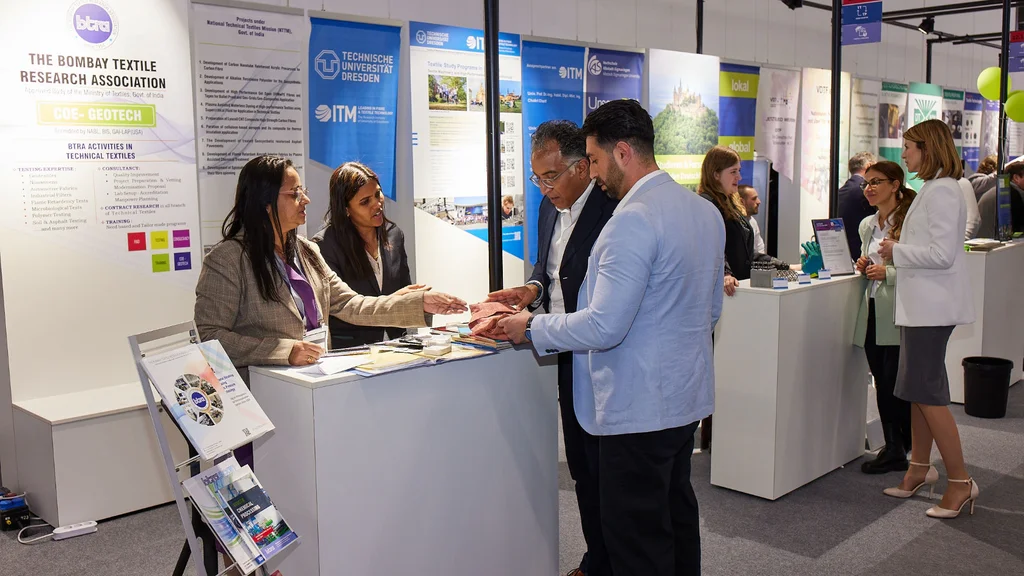
The expanded Campus & Research zone features over 40 institutions from Europe, Asia, Africa, and South America, making it a key destination for cutting-edge textile R&D.
Leading participants include:
- Saxion University of Applied Sciences
- University of Minho
- RWTH Aachen University
One standout innovation comes from RWTH Aachen’s textile-based indoor navigation system designed to improve accessibility for visually impaired users—demonstrating how textiles are evolving beyond traditional applications.
Start-ups Disrupt the Textile Industry with Smart Solutions
Start-ups are no longer side attractions—they are central to innovation at Techtextil and Texprocess.
Notable innovations include:
- Circular and recyclable textiles from Climatex
- Advanced cellulose fibre technology from qCella
- Additive fibre placement by R.O.A.M Systems
- AI-driven production SaaS by Prodactive Solutions
These companies are solving critical industry challenges such as:
- Waste reduction
- Production inefficiencies
- Lack of real-time quality control
How AI Is Transforming Textile Manufacturing
Artificial intelligence is one of the strongest ranking angles—and here’s where we push harder than competitors.
At Texprocess, AI applications include:
- Automated textile defect detection
- Real-time quality control systems
- AI-powered training software for apparel production
- Optical sorting systems for textile recycling
Companies like Willy Italiana and Picvisa are demonstrating how AI can:
- Reduce operational costs
- Improve accuracy in inspection
- Enable scalable textile recycling
Why These Trade Fairs Matter for the Future of Textiles
Techtextil and Texprocess are more than exhibitions—they are innovation accelerators.
They:
- Connect global research with commercial applications
- Enable cross-border partnerships
- Speed up time-to-market for new technologies
As stated by Sabine Scharrer of Messe Frankfurt, these collaborations are key to transforming ideas into scalable solutions.
Future Trends Emerging from Techtextil & Texprocess 2026
Based on showcased innovations, key trends include:
- AI-driven textile automation
- Sustainable and circular materials
- Smart textiles and functional fabrics
- Digitalized production ecosystems
These trends indicate a shift toward fully integrated, tech-driven textile manufacturing.
FAQs
What are Techtextil and Texprocess?
They are leading international trade fairs focused on textile materials, processing technologies, and innovation.
How is AI used in textile manufacturing?
AI is used for defect detection, automation, quality control, and production optimization.
Why are textile trade fairs important?
They connect global industry players, promote innovation, and accelerate commercialization of new technologies.
Learn next about Techtextil & Texprocess Forums 2026: AI, Sustainability & Textile Innovation Insights