

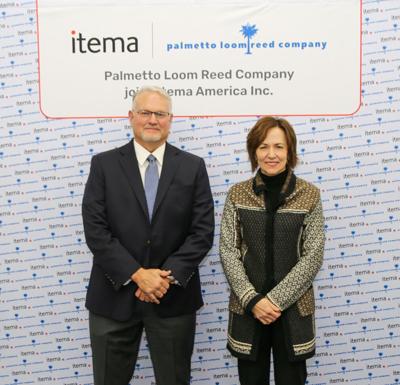
In a move signaling both confidence in the future of U.S. weaving and a strategic push toward deeper service capabilities, Itema America, the American subsidiary of Itema Group headquartered in Colzate (Bergamo), Italy, has acquired Greenville, S.C.-based Palmetto Loom Reed — one of the nation’s last remaining domestic reed manufacturers and a company with more than a century of family ownership.

The deal pairs a global weaving machine leader with a 113-year-old American supplier whose products remain essential to fabric formation. For Itema America, whose headquarters is located just up I-85 in Spartanburg, the acquisition represents a deliberate step toward becoming a full-service partner for regional textile manufacturers.
For Palmetto, it ensures continuity, cultural alignment and succession as fourth-generation owner Gladys Richardson considered the long-term future of the business.
The acquisition comes amid continued consolidation across the textile supply chain, as manufacturers prioritize service speed, localization and technical support.
A long courtship, timed by the market
While the acquisition is newly finalized, discussions between the companies date back a few years.
“We actually started talking five or six years ago,” Richardson said. “I was in my 50s and thinking about the future. My children went on to do other things, so it was always in the back of my mind — but I just wasn’t ready.”
Itema America President Scott Malcolm recalled the early stop-and-start nature of those conversations.
“I had already warmed Itema Group management in Italy up for this — letters of intent, nondisclosure agreements — and when I finally came back to Gladys, she said, ‘I changed my mind,’” he said with a laugh. “She wasn’t saying never. She just wasn’t ready.”
Once Richardson confirmed she was ready, Malcolm returned to Itema’s leadership in Italy to revive the proposal, “The Itema Board of Directors, led by the CEO Ugo Ghilardi, believed in the transaction and supported every phase of the agreement,” he said.
Preserving a 113-year legacy

Palmetto Loom Reed dates back 113 years, founded by Richardson’s great-grandfather, William Jefferson Richardson, and passed down through successive generations of William Henry Richardson I, II and III before Gladys became the fourth-generation leader.
Richardson has been with the company since 1994, working alongside her father and brother before assuming the presidency.
Asked what it feels like to place the family business in new hands, she did not hesitate: “It’s the best,” she said. “I’ve been approached in the past by others, but as far as putting customers first and valuing employees like a family-run business, Itema felt aligned with how we operate. They respect their people. We do that too. I have a lot of loyalty — I play a lot of roles there.”
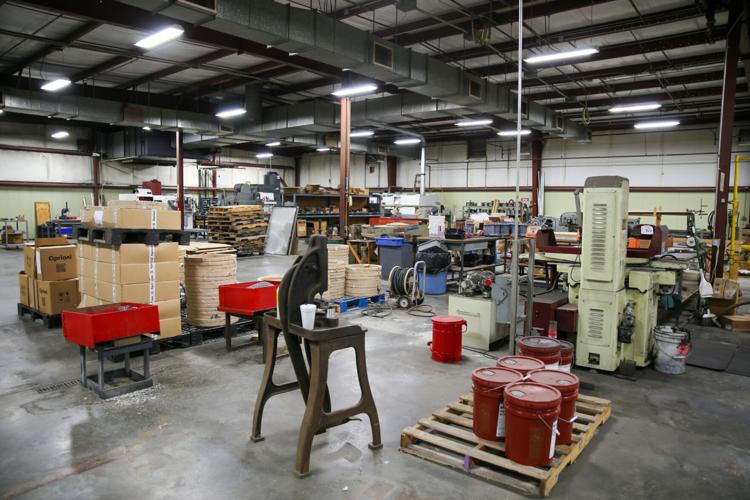
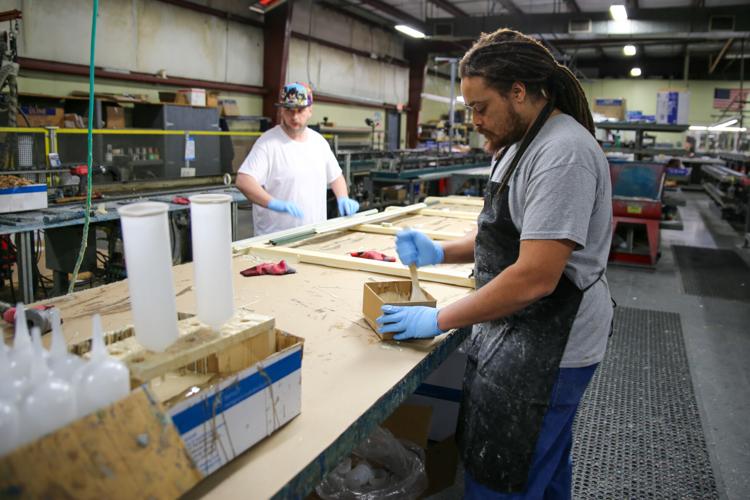
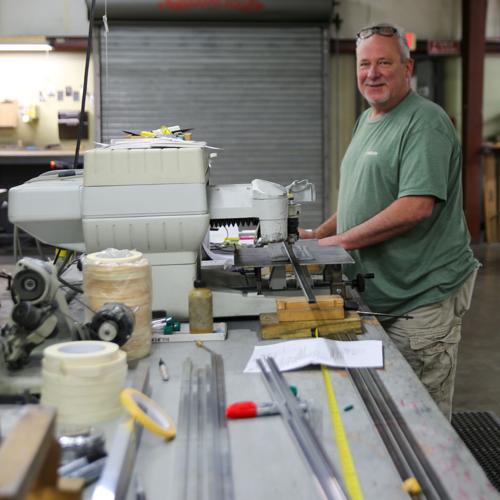
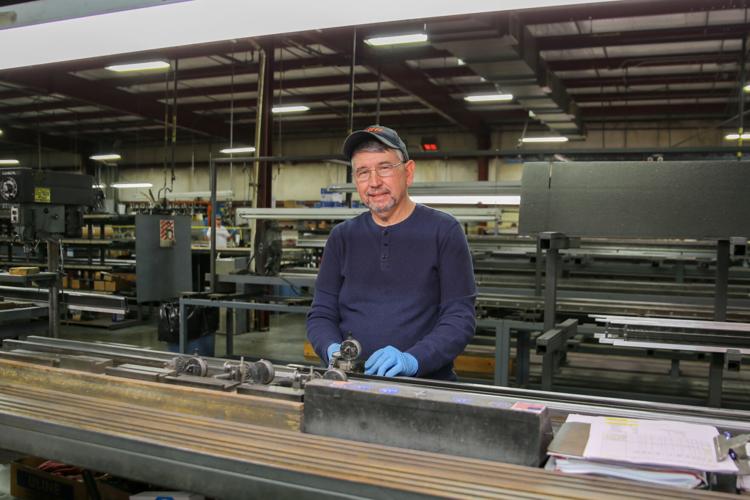
Today, the company, located just off White Horse Road in Greenville, employs about 18 people and operates multiple reed-making and machining systems while maintaining a diverse customer base primarily across the United States, with select exports overseas.
Why now?
For Richardson, the decision ultimately came down to stewardship rather than sentiment.
“My father always said, ‘Keep it in the family,’ but if it doesn’t make sense anymore and you don’t have a legacy to leave it to, they wouldn’t want me to collapse on top of myself,” she said. “I’m 60 — it’s time to train somebody, time to pass it on. I just don’t have that opportunity within the family.”
Reflecting on the milestone, she added with a smile, “My great-grandfather would say, ‘Way to go, girl.’”
Importantly, Richardson will remain with the business for the foreseeable future, ensuring continuity for employees and customers alike.
Building a full-service textile partner
From Itema’s perspective, the acquisition is less about consolidation and more about capability.
“We want to be a full-service company,” Malcolm said. “We want to take care of our customers from top to bottom any way we can — and we’re going to be looking to do more of that, not less.”
The addition of reed manufacturing complements Itema America’s existing offerings in machinery, spare parts, repairs and technical support.
As Matteo Mutti, Itema Group’s Chief Sales and Service Officer and Itemalab Head of Textile Innovation, explained: “What we are providing with this acquisition is further service. The idea behind Itema America is to become the company every textile producer in the United States looks for when they are in trouble. You need something — Itema can provide it.”
He continued: “Adding reeds, stretch nozzles, beam refurbishing and spare parts empowers our capacity to be the right answer to the needs of a business that is smaller than it used to be — but still very much alive.”
Strategic advantages of domestic manufacturing
The move also strengthens Itema’s manufacturing footprint in the Americas.
“There are many advantages to producing reeds on American soil,” Mutti said. “They are made in dollars, not euros, which today are expensive. There are no tariffs, no shipping costs. We are much quicker with deliveries.”
Itema already runs a large reed facility in India, with more than 100 employees, and a presence at its Italian headquarters. Mutti sees opportunities to share work and technology while still leveraging Greenville’s local responsiveness.
He also recognizes the competitive challenge: roughly half of the U.S. reed market is still supplied from abroad. “Maybe tomorrow it will be 70 percent local and 30 percent abroad,” Mutti said. “This is the challenge — and we have everything to win it.”
The acquisition also creates opportunities to better serve customers in Central and South America, markets Itema views as critical to future growth, he added.
Opening doors — carefully
While executives acknowledge the deal will expand customer relationships, Malcolm emphasized the company intends to approach those opportunities respectfully.
“Palmetto does business with everyone,” he said. “If customers want to talk just to Palmetto, they can talk just to Palmetto. But we hope they’ll entertain the offerings of Itema while they’re there.”
The strategy is less about aggressive cross-selling and more about proximity.
“In this market, people don’t have time anymore,” Richardson added. “Being full service means you hopefully get on their speed dial.”
No immediate changes planned
Despite long-term synergy opportunities, both sides stress stability is the immediate priority. Operations in Greenville will continue with the same employees and leadership, now under Itema America ownership.
“This is a successful, profitable company for 113 years, with a respected brand, and we don’t want to change anything. We love it,” Malcolm said.
Understanding the reed — Small component, big Impact
For non-weaving readers, the reed can seem like a quiet component compared to the looms, warpers and winders that dominate the plant floor. But in weaving, it’s essential. “It separates yarns in a loom and facilitates the actual fabric formation,” Richardson explained. “You absolutely need reeds to make anything.”
In today’s market, that simple function has become more complex. The shift from commodity cotton sheeting and shirting to high-performance fabrics — for automotive, aerospace, defense and industrial uses — has driven up demands on durability, precision and customization.
“The yarns used today — especially in technical textiles — are aggressive,” Malcolm said. “We’ll have to look toward coatings and different layouts to handle these applications. The old days of cotton sheeting and apparel were easier. Now it’s more engineering.”
Each reed is customized to a specific machine and product, requiring a blend of craftsmanship and technical expertise.
Market reality — and resilience
The acquisition comes at a time when the U.S. textile industry continues to navigate plant closures, shifting global demand and economic uncertainty.
“We feel like we’re in a holding pattern,” Malcolm said. “Nothing bright is happening, nothing too dim — just flat. We’re waiting for something to stimulate activity.”
Yet, the company leaders remain confident. “We still believe in this market,” he said. “And we’re going to be stronger because of this.”
Richardson pointed to resilient end markets such as automotive and defense. “Those things are not really going away,” she said. “And the more innovative your customers are, the more likely they’re going to stay.”
Over time, Palmetto has also consolidated part of the remaining reed-making capacity in the U.S. A few years ago, it acquired Carolina Loom Reed, a smaller competitor whose owner was looking to retire.
Even in downturns — whether NAFTA, WTO impacts, the Great Recession or COVID-19 — Palmetto saw orders keep coming, she said.
“That taught me that this market still needs our product no matter what,” Richardson said. “Business might go down a little bit, might go up a little bit, but even in the worst of times, we still get orders. So it’s a nice, steady business in general, if you can roll with the business cycles.”
That history has left Palmetto in a rare position: as one of the last fully capable domestic reed manufacturers in a market that once had five significant global players.
Advanced materials — from aircraft components to high-performance protective fabrics — increasingly define the weaving landscape, she said. “What’s left is sharper,” she said.
Trust at the center of the deal
Itema Group is best known globally for its rapier, air-jet and projectile weaving machines, with installed bases from apparel to technical textiles. But in North America, Malcolm and Mutti say the company’s identity is also tied to service, spare parts and lifecycle support.
Ultimately, Mutti said the decision in Italy for Itema America to purchase Palmetto came down to confidence in leadership and long-term strategy.

“Because we trust you,” he said of Malcolm’s proposal. “In the end, what we are providing to our customer with the acquisition of Palmetto is further service. The idea behind Itema America will be more and more to be a kind of company that every textile person here in the United States should look for when they are in trouble. So you need something — Itema America can provide it. This is a good move that brought a lot of pluses.”
Adding reeds — and Palmetto’s stretch nozzles, beams refurbishing and broad spare-parts capabilities — is, in Mutti’s words, “a good piece of the big puzzle.”
For Itema, plugging that hands-on know-how into its global innovation and service network — from Italy to India to the Americas — is central to the acquisition’s logic.
“We see that [Palmetto] can be … the right answer to the needs of this market,” Mutti said. “We have everything to win this challenge and to be successful.”
A signal of commitment
At a time when some suppliers are retrenching, the acquisition sends a different message — one of investment, localization and belief in the future of regional manufacturing.
For Malcolm, the takeaway is straightforward: “Itema America is stronger because we’re doing this.”
For Richardson, the focus remains on continuity. “If it makes sense, they wouldn’t want me to watch things dwindle,” she said. “This was the right time — and the right partner.”
And for an industry that often measures success in generations rather than quarters, that alignment may prove the deal’s most enduring value.
Source: Itema